Observability stories
Engineering teams can now keep decisions, fixes and costs in one place as CodeRabbit brings its AI agent into Slack.
Broadcasters can now cut latency and costs during major live events as Google expands regional capacity and adds new monitoring tools.
Businesses are turning to observability software to govern AI traffic and secure hybrid systems, as IDC sees the market rising to USD $4.39 billion by 2029.
Rising AI infrastructure bills are pushing teams to hunt for idle chips and bottlenecks, as GPUs account for 14 per cent of compute costs.
Enterprises get tighter controls for autonomous AI agents and Cloud SQL backups as Rubrik expands its Google Cloud security stack.
Its new fabric promises lower latency and more bandwidth for training, as Google links up to 134,000 TPU 8t chips across sites.
Nearly half of organisations now treat mixed on-premise and cloud estates as permanent, with security and cost pressures mounting.
The new tools could let firms’ AI agents act on live data more securely across clouds, while cutting rebooking from hours to minutes.
Users of Loki should see far quicker searches for rare log values, after Logline’s indexing tech cut one UUID scan from 3.5 TB to 8 GB.
The release aims to ease log searching and dashboard management as engineering teams wrestle with rising telemetry volumes and system complexity.
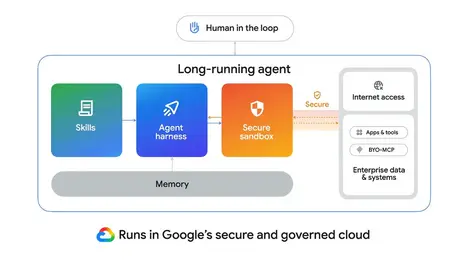
Businesses can now let Gemini agents run for hours or days, while new controls aim to keep AI workflows traceable and secure.
Customers will build and manage AI agents in one place as Google Cloud folds Vertex AI services into Gemini Enterprise Agent Platform.
The launch aims to let firms and software agents use Salesforce data and workflows inside coding tools and collaboration apps, cutting build times by up to 40%.
Enterprises could gain tighter control over AI deployments as the new stack combines governance, security and on-premise data sovereignty.
Adoption is rising as customers report faster fixes and lower running costs, with one college cutting troubleshooting time by 90%.
Analysts can now triage threats and trace outages from inside AI tools, as Elastic’s public preview cuts dashboard switching.
The new tools aim to help firms spot faulty AI outputs and data risks sooner as production deployments outpace monitoring methods.
Machine learning teams could cut drift and operational overhead as Redis folds feature definition, orchestration and serving into one managed platform.
Native checks will now flag prompt injection and data leakage across more of the AI agent stack as enterprises push systems into production.
The retailer says the shift will improve system performance and set up its next phase of AI tools for operations and internal workflows.